Agentic CRM after Dreamforce 2026: what it means for small business
On September 15, 2026 Salesforce introduced Koa, a CRM reasoning model, and AIforce, a layer that lets AI agents work with CRM data from other tools. Here is what that means for a small team and what you can already run on your own customer base.

Dreamforce 2026 made "agentic" the word of the season for CRM. The announcements target large Salesforce customers, yet the principle behind them applies to a five-person sales team as much as to an enterprise: an AI agent can only act well on records that are complete and current. This guide sums up what was announced, with links to the primary sources, explains agentic CRM in plain terms and lists the AI and automation a small business can switch on in CRMiUS AI functions today.
What is agentic CRM?
Agentic CRM is a CRM in which an AI agent completes multi-step work on customer data: it reads the record, decides on the next step and carries it out within the user's access rights. For a small business the condition is the same as for Salesforce customers: the agent is only as useful as the customer records, owners and deadlines it works on.
- Salesforce Koa: a CRM reasoning model for Agentforce, in pilot now, general availability expected in winter 2026 in U.S. regions
- Salesforce AIforce: CRM data, workflows and permissions brought to other AI tools such as Claude and Slack
- Every agent sees only what the person asking can see: permissions decide the agent's reach
- In CRMiUS: an AI voice assistant that calls new leads, rule-based follow-up tasks, plans from $100 a month
How an AI agent works on a CRM record
Behind every agent demo at Dreamforce sits the same loop. Salesforce's own example is a Slackbot that flags accounts going quiet, reviews the related support cases and Slack threads, reassigns owners, creates follow-up tasks and drafts win-back emails. Each step reads or writes the customer record.
- 01TriggerA new lead, an incoming call, an account that went quiet
- 02Read the recordContacts, history, owner, open tasks and deadlines
- 03Decide the next stepCall, reassign, create a task, draft a message
- 04Act within permissionsOnly on records the user behind the agent may see and edit
- 05Log the resultStatus, task, transcript or draft saved to the record
- A person takes overThe manager continues from the logged result and corrects the agent where needed
What Salesforce announced at Dreamforce 2026
On September 15, 2026 Salesforce announced AIforce at Dreamforce and, on the same day, Koa, its first CRM reasoning model for Agentforce, built on NVIDIA Nemotron. The table sums up the announcements as Salesforce describes them in the Koa press release and the AIforce announcement.
| Announcement | What it is | Status, per Salesforce |
|---|---|---|
| Koa | CRM reasoning model for Agentforce, post-trained from NVIDIA Nemotron 3 Super on synthetic scenarios from more than 14 industries; "no customer data was used" to train it | Select pilot customers now; general availability expected in winter 2026 in U.S. regions |
| AIforce | A live interface layer that brings Salesforce data, workflows and governance to any AI interface | Announced September 15, 2026 |
| Claudeforce | Salesforce in Claude: a prebuilt MCP server with 37 sales skills, from prospecting to pipeline cleanup | Beta for all customers |
| Slackforce | Salesforce context in Slack: Slackbot, Slack CRM for creating accounts and logging call notes, shared surfaces | Part of AIforce |
| Agentforce Coworker | An AI teammate inside the Lightning interface that surfaces insights and takes action | "One hundred thousand users activated Coworker within its first 35 days" |
On Salesforce's own CRM benchmark, with tasks such as updating an opportunity, routing a case and scheduling a follow-up, Koa "matches or exceeds leading model performance on CRM actions with three times fewer errors". The benchmark is Salesforce's own, so treat the figure as the vendor's claim.
Sources: Salesforce, Koa reasoning model press release, 15.09.2026; Salesforce, AIforce announcement, 15.09.2026.
What agentic CRM changes for a small business
- The CRM becomes the source of truth
- Agents move into the tools a team already uses: chat, email, AI assistants. They all read and write the same customer record, so a gap in the record shows up in every tool at once.
- Permissions set the agent's reach
- AIforce runs on existing permissions, so "every agent sees only what the person asking can see". The same rule works in any CRM: set roles and access rights before you give an assistant access.
- Clean data comes before AI
- An agent that reassigns a quiet account needs a correct owner; one that schedules a follow-up needs a real deadline. Duplicates and stale statuses turn into wrong actions.
- The first job is usually narrow
- Small teams get value from one repeated step handed to AI, such as the first call to a new lead, before they let an agent act across the pipeline.
AI and automation a small business can run in CRMiUS today
In CRMiUS, AI and rules take over specific repeated steps, and each of them writes its result to the same record your team uses:
| Job | What happens | Where in CRMiUS |
|---|---|---|
| First call to a new lead | PilotAI calls each new lead with a phone number, asks your qualifying questions, saves the recording, transcript and summary to the lead card and moves the lead to the next status | AI functions: PilotAI |
| Calls at a busy hour | PilotAI answers calls to your number, asks for name, email and request, and creates a lead with the source you chose | AI functions: PilotAI |
| Follow-up tasks by rules | CRMiUS Automation changes task statuses, assignees, due dates and reminders according to your rules | Process automation |
| Next contact with a lead | A reminder on the lead or customer goes to the responsible manager on the chosen date | Lead management |
| Leads from Google listings | CRMiUS GMB Importer searches businesses by keyword and location and imports them as leads and contacts | CRM marketing |
PilotAI terms are agreed individually. Rules for automated and AI calls differ from country to country, so call people who left their number with you and check the rules of your market before launch.
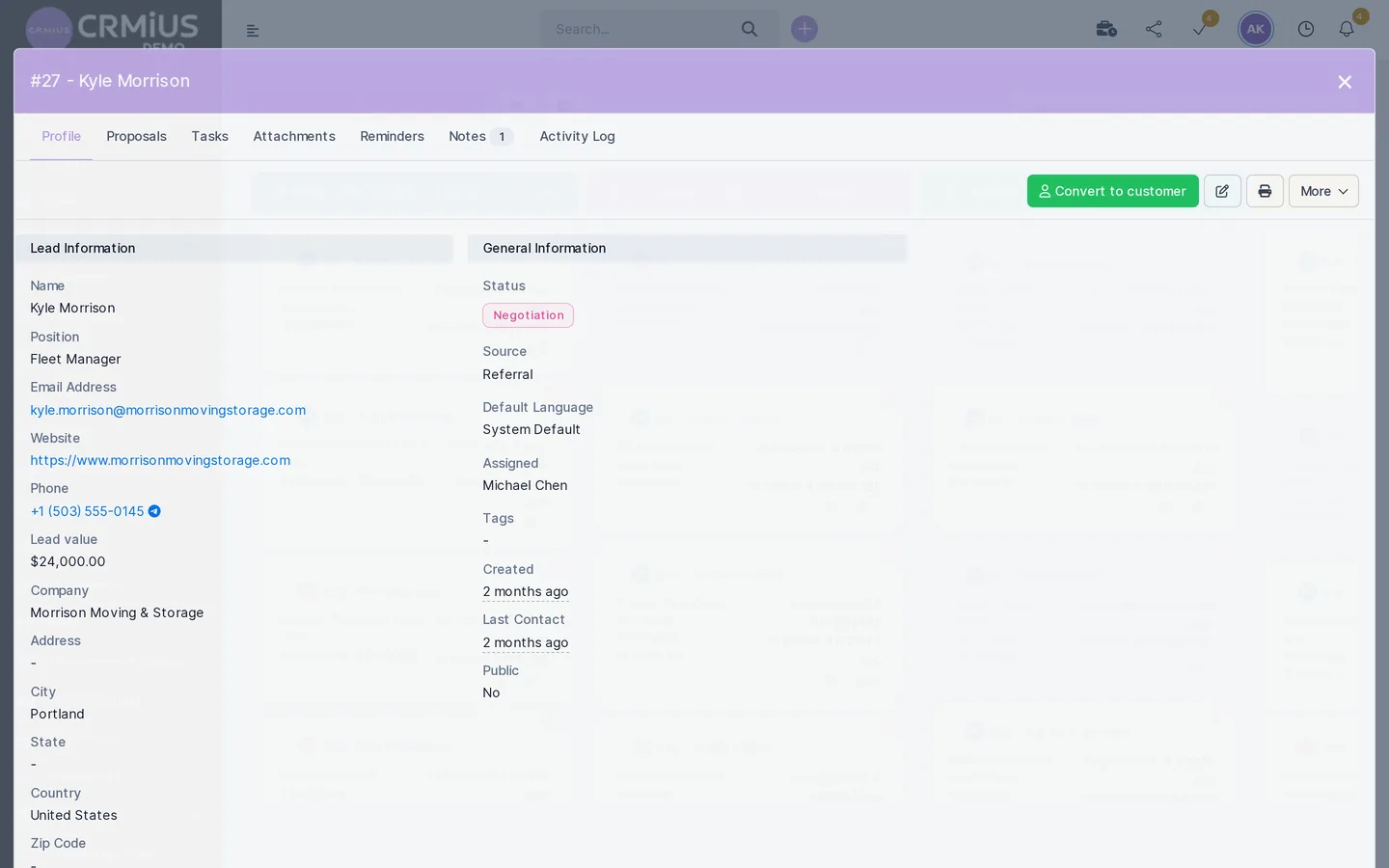
Four data checks before you switch on AI
An AI agent reads and writes the customer record with every action, so that record has to be complete and current. Run four checks first:
- One card per customer. Contacts, notes, files and reminders sit in one record in the contact and customer module; duplicates are merged before the AI starts working.
- Lead statuses match reality. Every lead on the lead board has a current status, so a status change can safely trigger a call or a task.
- Every open task has an owner and a due date. Reminders and automation rules in the task module work only on tasks with a date.
- Roles and access rights are set. Give each person, and the assistant acting for them, only the records they need through customizable roles.
If your customers still live in spreadsheets and inboxes, start with the move itself: CRM implementation: where to start to avoid losing customers walks through it in seven steps.
How to start with AI in CRMiUS
- Demo. We show PilotAI on a call and look at your lead sources and statuses.
- Script. You send the opening line, questions, limits and knowledge files; we set up the assistant and the two statuses that start and follow a call.
- Test calls. The assistant first calls your own team; you read the transcripts and adjust the script.
- Live leads. New leads with a phone number get their first call from PilotAI, and managers work from the summaries.
Price: CRMiUS plans cost $100 a month (Basic) and $150 a month (Advanced); Corporate is priced individually. 10% off with annual payment, individual terms from 10 users, 14-day free trial with full access and no bank card. PilotAI terms are agreed individually; module setup and team training are available as services, and support works 24/7 on every plan. See all plans.
Related reading: CRM for small business, what is CRM and how it boosts sales and, for stores getting ready for the holiday season, the retail CRM checklist for Black Friday 2026 and retail CRM with POS.
FAQ
What is agentic CRM?
Agentic CRM is a CRM in which an AI agent completes multi-step work on customer data: it reads the record, decides on the next step and carries it out within the user's access rights, for example creating a follow-up task or drafting an email.
What is Salesforce Koa?
Koa is Salesforce's first CRM reasoning model for Agentforce, announced on September 15, 2026 and post-trained from NVIDIA Nemotron 3 Super. Select pilot customers use it now; general availability is expected in winter 2026 in U.S. regions, according to Salesforce.
What is Salesforce AIforce?
AIforce is a layer announced at Dreamforce 2026 that brings Salesforce data, workflows and permissions to other AI tools. It launched with Claudeforce, Slackforce and Agentforce Coworker, and agents see only what the person asking can see.
Can a small business use an AI agent in its CRM today?
Yes, if the agent has a clear job and clean data to work on. In CRMiUS the AI voice assistant PilotAI calls new leads and answers incoming calls, and rule-based automation creates follow-up tasks and reminders; PilotAI terms are agreed individually.
What data does an AI agent need in a CRM?
One record per customer with contacts and history, lead statuses that match reality, an owner and a due date on every open task, and roles that limit what each user, and therefore the agent, can see.
How much does CRMiUS cost?
Basic is $100 a month, Advanced (Pro) $150 a month and Corporate is priced individually. Annual payment gives 10% off, teams of 10 or more users get individual terms, and every plan starts with a 14-day free trial without a bank card.
Put one AI job to work on your customer data this quarter: import your leads and set the statuses during the free 14-day trial, then agree PilotAI terms with us and read the first call summaries.